

What do we know about La Llorona? What version of her do you know? To those that don’t La Llorona, the story
goes that she was a beautiful young woman whose husband left her for another woman leaving, her to take care of their
two disobedient children. The rage she felt was unbearable, and she ended up drowned her children. Stunned by what she did, she
tried to save them but ultimately drowned herself. Her spirit, though, stayed in search of her two children. If you misbehave, La
Llorona will snatch you because you’ll remind of her children. “Si te portas mal, La Llorona va venir por ti ( if you’re bad, La
Llorona will come for you), “ my family would tell my cousins and me growing up. The ghostly woman with long black hair,
long white dress, and long wailing for her children, spooked us all into not disobeying our family.
But why was she described as beautiful? Why not automatically describe her as hideous or old? Recently, in my
community, if a child is misbehaving, you’d point at a random man and say,” Do you want to go home with that man? If you keep
misbehaving, he'll take you". In that case, I suppose a beautiful woman taking me would not be too bad. There must be more.
Why, when her husband abandoned her, which she had no control over, did everything come crashing down? Surely, this is not
simply a tale that haunted me as a child.

“La Llorona stories across cultures part 1 of 3,” The Chicano Gothic, March 18, 2014, Artist Alyosn, Published under Creative Commons License
A shrieking siren, a blank woman with long dark hair dressed in white tattered clothing, coming after children, a
mourning mother screaming for her children, a temptress, a significant figure of obedience for parents, a representation of the
oppressed; all of these are depictions of the ways La Llorona. La Llorona assumes many faces, changing depending on who is
telling her story and the purpose behind it, for "Folklorists find stories about monsters to be multidimensional, informing
people about themselves and eliciting different emotions, including anxiety" (Wolfson). There are countless retellings of La
Llorona, for she has been passed down by oral traditions, in art, music, and other media.
* * * *
Primarily focusing on oral traditions, La Llorona is part of a family's tradition and identity, specifically in Mexican Culture.
In one of her stories, she is an indigenous woman, and her husband is a wealthy Spaniard. Some state that this version of the story
illustrates a theme of colonization, even more with La Llorona described to have similar characteristics to those of Dona
Marina, Malintzin. Now Malintzin was the interpreter to the conquistador, Hernán Cortés, and she mothered his sons. In this
case, to most, she was punished for being a traitor to her people, but there is another side that does not paint her as
a traitor, which is Reseda, a woman born in San Antonio tells us:
When the Spanish arrived in Mexico, they were impressed by the beauty of the Indian children. The Spanish
took the children (the most beautiful) and gave them to their wives. Some of the Indian women killed their
children in order to keep the Spaniards from taking them. La Llorona is one such woman. She is now searching
constantly for her children, whose faces she sees in all children. She kills the children to be united with her
own again (Hawes).
Given the twist in these tales due to colonialism, in Aztec-Mexica culture, La Llorona was once similar to Cihuacōātl, a
fertility goddess and snake woman. She is also associated with midwives or Chiuateteo, the worshipped spirits of women who
died in childbirth ( Perez). In this way, she is a powerful woman who protects all children and women, which is far from a ghost
who takes children and seduces men. By these statements, was she actually trying to save her children from a certain life of
colonial rule? If so, then "La Llorona lamenting for her children and her own demise can be a metaphor for Spanish colonization
and the fall of the Aztec empire" ( Tomio-Armorer 55). These versions of La Llorona depict her as indigenous, going back to her
roots, but she is also a representation of Mexican and American identity, a mestiza.
Being depicted as a mestiza illuminates a different story, such as Orquidea Morales' story, which states that she heard La
Llorona was about a woman whose husband crossed the border into the U.S. for work, and that she tried to follow him with their
child. Her child dies in the river while crossing, and she as well, for she tries to save him. (Hawes ) The meaning in the river has
shifted to something more symbolic, as it is a path towards another life that can lead to death. A tale that is quite common
among immigrants seeking a better life for their families, for different reasons. She does not physically drown her child, but
signifies more of the risks and sacrifices many immigrants take for a better life.
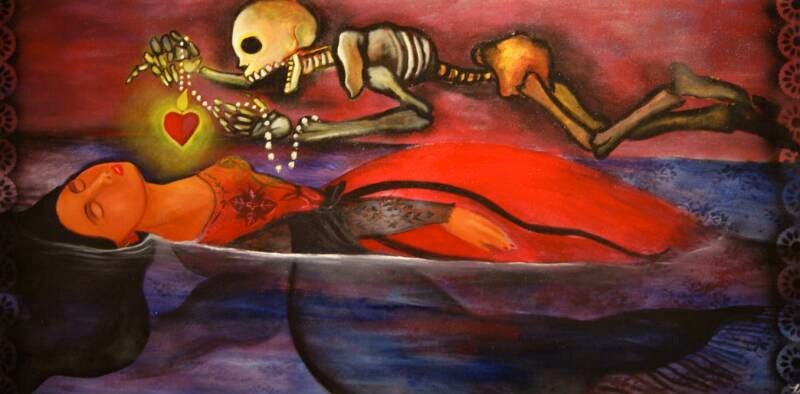
La Llorona Durmiente, oil on canvas, 2012 Hector Garza
In a society where women cannot work or provide for their children, I would not be surprised if a woman spiraled because
of what she could do now to support her family. There are some tales that when her wealthy sweetheart left, she stabbed her
children because they were his, and took revenge on men by killing them. A man did her wrong, so she took matters into her
own hands. I do think of Medea and her story as a form of reclaiming her power, which is not surprising when some call La
Llorona a Mexican Medea.
Another story of hers includes being punished for fooling around, tempting men, and not being married. Disgraced by her,
her family kicks out, leaving her with nothing. When she tried to ask for forgiveness, she was cursed to roam until she found all
her children. Is her punishment primarily because she is a woman and did not follow social guidelines? Her husband, who left
for a younger wife, what happened to him? Did he get punished for running from his husband’s societal duties, or did he have a
new life with a new family? Being a woman, in this case, means getting married, having children, and if your husband leaves
you, then you were not good enough.
The myth of La Llorona doesn't scare me as it did as a child, but instead frightens me about how much Mexican culture
focuses on societal standards. Even with other ghosts that haunt us, they are monsters like the Cucuy, depicted with claws and a
dark shape. Here, we have a woman, a being used as a representation of what not to do in life. She is used as a representation of
what lifestyle not to go towards because it goes against certain religious and societal beliefs.
We even go further in depth into the most gruesome stories of La Llorona, including the mutilation of taking young girls'
faces off. These stories were primarily told by young girls, describing La Llorona as a frightening ghost that attacks you. The
theme of mutilation can symbolize castration due to the loss of children, beauty, and life. By taking young girls' faces, are we
stating that their lives are over because their beauty is gone? If we think back on some of her stories, she is a beautiful woman,
but then it is all taken away from her. In some matters, having a ghost woman coming for your face or soul is a motivator to
keep being "perfect" because if not, then you'll end up just like La Llorona, alone.
* * * *
A blank face changing based on who is telling her story, from post-colonial to modern times, to the hardships of being a
woman, La Llorona's story will change. Morales writes, “We can think about external monsters and ghosts, but what do those
ghosts tell us about ourselves? . . . reclaim this narrative of monstrosity right in the face of colonization and say, ‘I am proud to
be a monstrous being" (Wolfson).
In some way, aren't we all weeping, shrieking for our dreams and life against society, maybe not children to some, but to
that young woman, they were her life. La Llorona stands for more than a scary ghost; it is a myth that reveals society and the
identities within us.
Bibliography
Fernandez, Miriam L. “La Llorona and Rhetorical Haunting in Mexico’s Public Sphere”. Journal for the History of Rhetoric, 24:1, March 2021, https://doi.org/10.1080/26878003.2021.1881310
Hawes, Lomax Bess "La Llorona in juvenile hall,”; article published in Western Folklore, July. 1968. Manuscript/Mixed Material. Retrieved from the Library of Congress, <www.loc.gov/item/afc2014008ms1903/>.
Perez, Domino Renee. There Was a Woman: La Llorona from Folklore to Popular Culture. First edition., University of Texas Press, 2008.
Tomio-Armorer, Alexia. “The Legend of La Llorona: Historical, Cultural, and Feminist Significance”. Footnotes, vol. 13, June 2020, https://journal.lib.uoguelph.ca/index.php/footnotes/article/view/5938.
Wolfson, Sarah Quiñones. “Traitor, Ghost, Feminist Icon: Reclaiming the Stories of La Llorona.”, Los Angeles Times, 16 Oct. 2023, www.latimes.com/delos/story/2023-10-16/la-llorona-mexico-latin-america-horror-folklore.
Add comment
Comments