

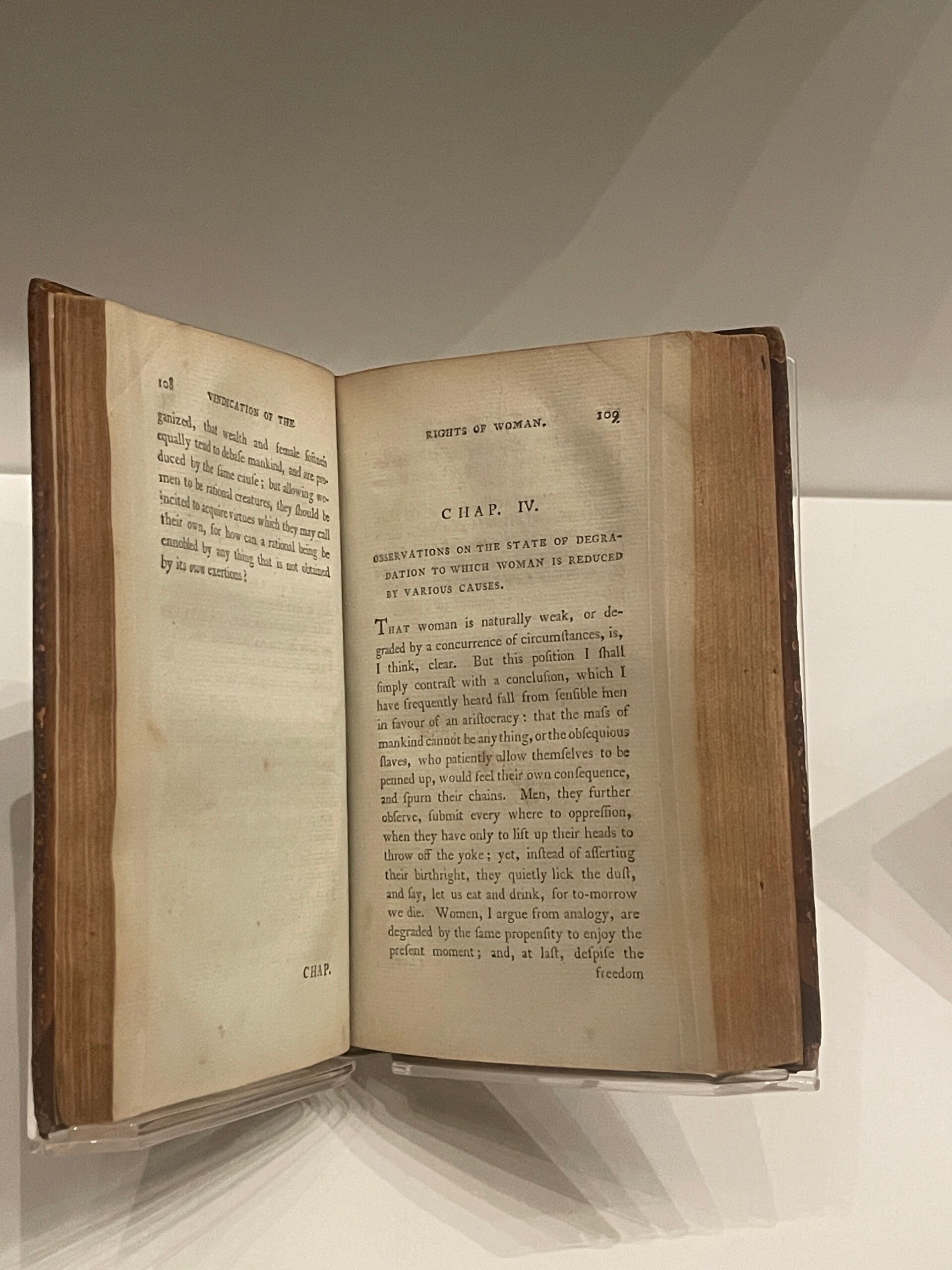
I did a project at the beginning of my spring semester in college. The project was over Mary Wollstonecraft’s A Vindication of the
Rights of Women. I became interested in the writing style she used to persuade her audience (knowing that it was primarily
all male). I read some other earlier works by women who were showcasing their work to an audience and looked for similarities
in their writing.
Feminine styles illustrate a softer, more group-focused approach. The goal is to make everyone feel equal. It includes hedging,
tag questions, weakened statements, and pronouns. In "Gender- Typical Style in Written Language" by Donald L. Rubin and
Kathryn Greene, they go more into depth on the gender-typical style, stating that,” in this manner, contrary to expectations
male authors wrote longer sentences than females. In contrast, females used more syntactic structures creating parallelism and
balance” (11). It isn’t about authority over another but an equal idea for both. There isn’t really a big difference in gendered types
of writing, but feminine writing is more emotional. Now, what does emotion mean? Is it the emotion that the dramatic or
gossiping claim that all women supposedly have in life? I began reading stories by women to focus on the rhetorical strategies
they used.

Sor Juana Ines de la Crus:” La Repuesta “(17th century)
De La Crus writes about how women can help more and understand society better if they are allowed to study and learn. She argues that an educated woman will not take from a woman's social knowledge by relying on the audience's emotional appeal to see where personally she has come because of her education and their guidance.
"Nor to the first obstruction do I have any response other than I am little worthy of your eyes; nor to the second, other than wonder, in the stead of thanks, saying that I am not capable of thanking you for the smallest part of that which I owe you …." 73
- By appealing to the audience's pride, it grabs their attention; even when used sarcastically, it helps them grasp the passage's true meaning. It may be/sound sarcastic, but I felt it as a way to show that I am grateful for you all, you are all everything, so can I have... It reminds me of "buttering" someone up before you go on to what you want to address. She is giving thanks, demonstrating that she is not trying to come across as insincere but is trying to put her audience in a pleasant mood to encourage them to listen to her request.
"How, without Logic, could I be apprised of the general and specific way in which the Holy Scripture is written? How, without Rhetoric, could I understand its figures, its tropes, its locutions? How, without Physics, so many innate questions concerning the nature of animals, their sacrifices, wherein exist so many symbols, many already declared, many still to be discovered?"(p. 75)
- The use of religion/ questioning. It shows power in words, and directly addressing these religious expressions appeals to the audience's emotions and their logical sense. The meaning of religion is to spread and teach others, but by using these questions, De La Crus shows how one can learn all of this even if one is not allowed access to an education system.
Mary Wollstonecraft: A Vindication for the rights of Women(1792)
Wollstonecraft argued for women's equality, against the society that held them down, and for women's education, using her audience's emotions to persuade them that this would improve society and benefit them.
"The subjects of these self-erected tyrants are most truly slaves, though voluntary slaves; but as slavery of any kind is unfavorable to human happiness and improvement, I will venture to offer a few suggestions, which may induce the subjugated tribes to revolt, and claim their invaluable birthright, their natural liberty" (p. 99)
- Uses parallelism with women and slavery. Giving parallelism helps with contrast: men did not see women as anything but comparing it to slavery gave a better understanding of how women stood in society to them. I shall add that, even though this piece is for women's equality, it was primarily about white women's place in society.
"The conclusion which I wish to draw is obvious; make women rational creatures, and free citizens, and they will quickly become good wives, and mothers; that is if men do not neglect the duties of husbands and fathers" (p.106).
- Makes a connection with equality between men and women. Showing how women can make life so much easier for men if just allowed to be educated and have sense in the world. She uses a sarcastic tone, but to her audience, which is primarily male, they would see this as a positive for them. She is making it seem as though this idea is excellent because it will benefit you.
"I presume that rational men will excuse me for endeavoring to persuade them to become more masculine and respectable" (p.96)
- Discusses men's natural ignorance, combined with a false sense of security, that leads them to realize this is the way to go. Wollstonecraft pokes at their masculinity by stating that, of course, you men have already thought of this because you are so smart. Once again, she is using their egotism to her advantage.
Hélène Cixous: "Sorties" (1975)
Cixous focuses on the transformation of breaking free from traditional norms and being silenced. Instead of women speaking their voice, their desire, their love, their body, the need to express themselves, in every way. She does this by doing her own analysis on women's relationships with traditional values, their sexuality, expressions of power, and identity, very heavily using pathos to get her point across
"Women must write her body, must make up the unimpeded tongue that bursts partitions, classes, and rhetorics" (p. 288).
- Cixous's use of the imperative voice, with the word "must", demonstrates a call to action. The use of alliteration toward the end with busts and partitions pushes women to speak up and be themselves.
" She goes away, she goes forward, doesn't turn back to look at her tracks. Pays no attention to herself. Running breakneck. Contrary to the self-absorbed, masculine narcissism, making sure of its image, of being seen, of
seeing itself, of assembling its glories, of pocketing itself again" (p. 286).
- The juxtaposition with women and the negativity in masculinity to showcase that women must reject these "glories" that men hold and for women to start having their own that embrace who they are, their identity. Cixous uses a specific language, employing images to compare it to the masculine figure. By showing women that this is what traditional norms are holding us back, she is urging them to break free from this patriarchy.
Tori Morrison: Nobel Prize Speech (1993)
In Morrison's 1993 Nobel Lecture in Literature and acceptance speech, she discusses the importance of language. Morrison tells how oppressive and racist language is limiting knowledge and taking away from its impact on the community. She uses multiple rhetorical strategies to emphasize her point with storytelling and perspectives to engage with her audience, and the power of language.
“Finally,” she says. “I trust you now. I trust you with the bird that is not in your hands because you have truly caught it. Look. How lovely it is, this thing we have done-together" (p.423).
- The use of storytelling to convey a life lesson provides equal understanding. Even beginning with the common phrase "Once upon a time...", she lays the foundation for a theme that, in some cases, everyone knows how to engage with her audience. She is not simply saying language is essential; she is narrating to the audience through a story. This message impacts the audience's emotions, making it more impactful.
- Morrison uses multiple perspectives in her story to highlight the importance of understanding viewpoints from different languages.
“You trivialize us and trivialize the bird that is not in our hands. Is there no context for our lives? No song, no literature, no poem full of vitamins, no history connected to experience that you can pass along to help us start strong?" (p.422).
- Parable with language as life and death/ Use of questions. In comparison to the history that affected everyone, it helps lend the story a sense of pathos. In stories, it is easier to identify the theme or message, and adding these questions helps push her point. We can also see how she argues that using certain words can undermine the importance of language's power.
- Her engagement with questions allows the audience to reflect on their own narratives and language use. She is not only starting to work together, but to participate in your own experiences to connect with those around you through the power of language.
Afterthoughts
All of these writings are from the early years, when women were pushing for education and rights. All of the writers added some form of personal connection with their audience. Cixous focused more on a woman-targeted audience, highlighting the negativity of masculinity and the positivity of speaking up and using one's voice. Wollstonecraft used their pride to make her male audience think this is an intelligent idea. De La Cruz did something similar, giving thanks for her education and the people in her life before stating how women can help even more. Morrison focused on having everyone come together and use their narratives to paint a picture that is welcoming and beautiful.
All of these women writing for a change is a demonstration and a call to every other woman to use their voice to create something extraordinary. Although I mentioned a few quotes, I urge you all to read their works! They are all in the bibliography below! Tell me, what do you all think? Who would you add to these writers?
Ritchie, Joy, and Kate Ronald, editors. Available Means: An Anthology Of Women’S Rhetoric(s). University of Pittsburgh Press, 2001. JSTOR, https://doi.org/10.2307/j.ctt5hjqnj. Accessed 7 Dec. 2025.